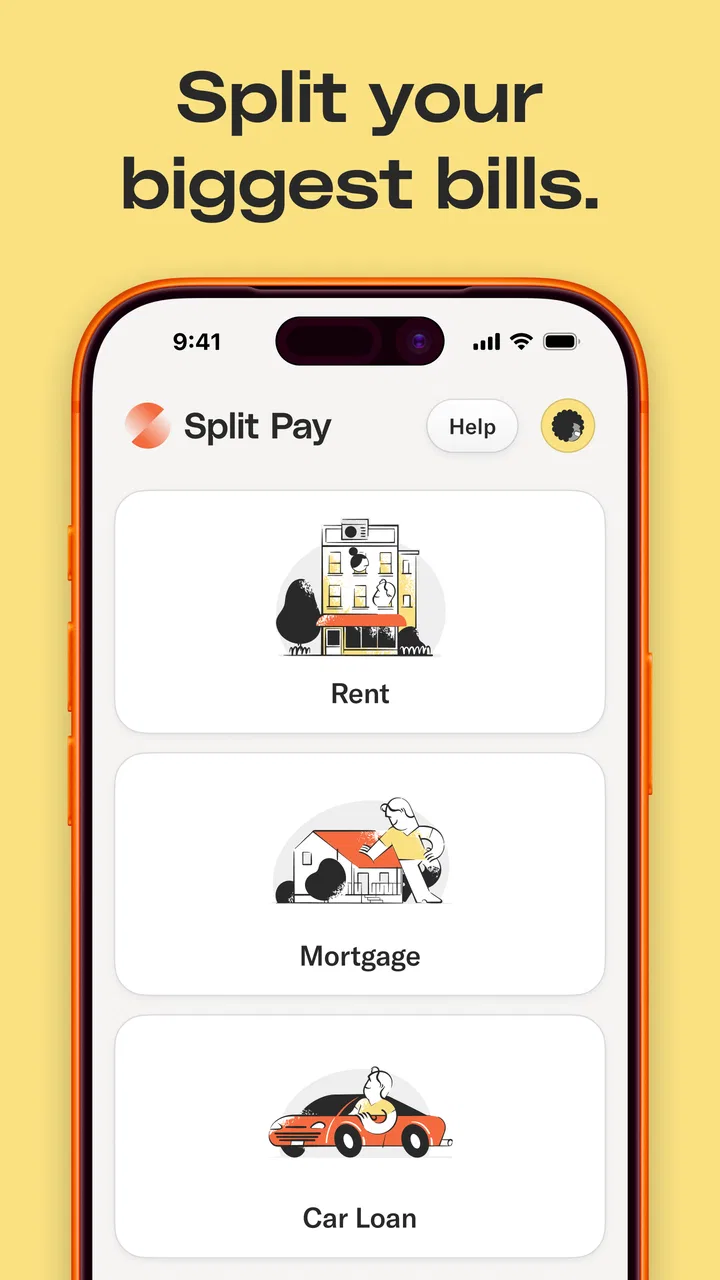
Split Pay: Split Bills in Two
- 4.9
- Rating
- 100.00K
- Installs
- Free
- Price

 Analysis by App-foxy
Splitting rent into two payments is the whole reason I would look at Split Pay – Pay Rent in Two instead of another budgeting app. It is a finance app from Visible Ideas, Inc. built around a very specific problem: rent can arrive as one large bill, while income often reaches your bank account in smaller, uneven moments. Rather than asking me to redesign my entire budget, the app focuses on changing the timing of that one major expense.
That narrow focus is also its appeal. I do not see it as a replacement for a complete banking app, a debt payoff planner, or a traditional credit card. I see it as a tool for people who can afford their rent overall but find the single due date awkward. In that situation, dividing the payment can make the rest of the month easier to manage. The important question is not whether paying in two parts sounds convenient; it is whether that arrangement matches my income schedule and spending discipline.
Why paying rent in two parts can matter
The app’s store summary is “Pay rent, build credit,” while its short description is “Split Pay.” Those phrases point to two connected ideas, but I would treat them differently when deciding whether to use it. The immediate benefit is cash-flow management: one large housing payment becomes a pair of smaller commitments. The credit-building angle may be attractive, yet the practical value depends on using the service consistently and understanding its terms rather than assuming that any rent payment automatically improves a credit profile.
You May Also Like

 Blood Strike: 2.5 Anniversary
Blood Strike’s Loadouts Turn Every Drop Into a Tactical Gamble
A close look at Blood Strike’s custom loadouts: how fast access to signature weapons reshapes its battle royale rhythm, rewards preparation, and narrows the gap between fights.

 Pandora - Music & Podcasts
Pandora’s Music Is Easy to Start, but Harder to Recover
Pandora’s strength is its low-effort path from a seed to a station. Its weak spot is how much confidence it asks you to place in connection, setup, and quiet recovery.

 8 Ball Pool
 Is Built on Rivalries, Rematches, and Routine
A close look at the rivalries, rematches, shared routines, and unanswered safety questions that turn a quick pool match into a persistent mobile community.

 Samsung Music
’s Quiet Strength Is Playing What You Already Own
Its reach comes less from spectacle than from dependable access to a personal library. That simplicity is both the app’s strongest retention engine and its ceiling.

 AccuWeather: Weather Radar
AccuWeather Review: A Quick, Clear Forecast for Everyday Decisions
For everyday plans, the best forecast is the one you can understand quickly. AccuWeather makes rain timing, radar, and local conditions easy to act on, with a few trade-offs.

 Hill Climb Racing
Why Hill Climb Racing Still Turns Crashes Into One More Run
A tiny car, a bumpy hill and one more upgrade: Hill Climb Racing keeps resurfacing because its simple chaos makes every near-miss feel personal.
More From Our News Desk



In everyday use, this distinction matters. If my paycheck arrives near the middle and end of the month, a single rent withdrawal at the beginning can leave too little money for groceries, transport, and utilities. A two-part schedule may reduce that early-month squeeze. It does not make rent cheaper, and it does not create extra income. It simply gives the payment a shape that may fit my cash flow better.
The strongest feature is not a flashy dashboard; it is the change in timing. That makes this a more specialized choice than general finance apps. A standard budgeting app can show me that rent is too large for one pay period, but it usually leaves me to negotiate the solution myself. Split Pay is aimed at the next step: arranging rent around the way money actually enters my account.
I also appreciate that the concept is easy to explain. Someone who has never used a budgeting tool can understand “pay rent in two” immediately. There is less of a learning curve than with an app built around categories, investment accounts, or complicated financial projections. The trade-off is that the narrow purpose means I should not expect a full picture of my financial life from it.
What the experience is really designed to solve
Imagine I am paid twice a month. Rent is due before the second paycheck, so I either have to reserve most of the previous paycheck or risk running short. With a split arrangement, I can plan one portion around the first income event and the other around the next. That can make a difference even when my monthly income is sufficient, because the timing of bills often causes more stress than the total amount.
This is especially useful for people whose budget is stable but tight. A freelancer with predictable monthly earnings but irregular deposit dates might also find the idea appealing, although that person needs to be more careful about setting aside the second portion before spending it. The app works best when the payment schedule reflects real income, not when it is used as permission to spend money that has already been committed.
One practical habit I would recommend is treating both portions as rent from the moment the month begins. I would not regard the second payment as “next week’s problem.” I would mark both dates in my calendar, keep a small buffer, and review the account before discretionary spending. This simple workflow prevents the convenience of splitting the bill from turning into a late-month scramble.
Using Split Pay in a normal month
My first step would be to install the app and check the setup carefully rather than rushing through it because the concept sounds simple. Split Pay is free, has an Everyone content rating, and runs on Android beginning with version 7.0. The current version is 1.7.15. Those details make it approachable for people using older Android devices, but I would still keep the app updated so the payment experience is based on the latest available release.
After opening it, I would focus on the actual payment schedule and the obligations attached to it. Before committing, I would want to know exactly when each portion is expected, how the arrangement interacts with my rent due date, and what happens if my balance is too low. These are not minor details. A split payment is only helpful if both parts arrive as planned and do not create a new problem with my landlord, property manager, or bank account.
The most useful way to evaluate it is to build a calendar around income rather than around the rent bill alone. I would place the first payment after the paycheck that can safely cover it, then reserve the second portion before the next major spending period. If the schedule does not line up with my paydays, I would not force it. A payment arrangement that looks manageable on paper can still be stressful if the dates fall just before income arrives.
There is also a psychological effect worth noticing. Seeing two smaller commitments can feel less intimidating than seeing one large withdrawal, but that does not reduce the total obligation. I would use a separate budget line labeled “rent part one” and “rent part two,” even if my banking app presents the money differently. That small bit of labeling makes it harder to mistake available cash for spare cash.
For a realistic example, suppose my rent is due early in the month and my income arrives in two regular deposits. The first portion could be planned alongside the first deposit, while the second is protected from everyday purchases until the later deposit. On the day groceries are due, I would check the amount still reserved for rent before deciding what I can spend. The app can support the payment structure, but my own tracking remains important.
Where the credit message fits
The possibility of building credit gives the service an extra reason to consider, particularly for someone trying to establish a stronger financial record through regular rent payments. Still, I would approach this as a potential benefit that requires responsible use, not as the main reason to sign up. Credit outcomes are important enough that I would read the app’s explanations closely and make sure I understand what activity is reported, when it is reported, and whether my payment behavior meets the relevant requirements.
That caution is not a criticism of the idea. It is simply the difference between using the app as a payment organizer and treating it as a guaranteed credit shortcut. If my priority is improving my credit, I would continue making every other payment on time and monitor my broader financial habits. Rent splitting may fit into that plan, but it should not replace basic credit management.
A useful advanced habit is to separate the two goals. I would judge the split feature by whether it improves monthly cash flow, then judge the credit feature by the actual reporting information and my consistency. Keeping those questions separate prevents me from accepting an inconvenient payment schedule just because the credit language sounds promising.
The renter who benefits most
The best match is someone with dependable income who experiences a timing problem rather than an affordability problem. If I can cover the full rent each month but struggle when it is taken all at once, the app addresses a genuine pain point. It may also help people who want a clearer routine for setting aside housing money instead of relying on one last-minute transfer.
It can be particularly sensible for a renter who already budgets by paycheck. That person is accustomed to assigning each deposit a job, so dividing rent naturally fits an existing system. The app becomes a focused part of the budget rather than another financial account to check without a clear purpose.
I would be more hesitant if my income is unpredictable, my account frequently reaches zero, or I am already behind on bills. In those cases, splitting rent may disguise an affordability gap without solving it. A conversation with the landlord, a broader spending review, or free financial counseling could be more appropriate. The service is not a substitute for having enough money to meet the full housing obligation.
I would also skip it if I prefer to keep all payments under my own control and already have a reliable method for reserving rent. Someone who receives a monthly salary before rent is due may gain little from adding another payment process. For that user, a normal bank transfer and an automatic savings rule might be simpler.
Trade-offs I noticed before relying on it
The first trade-off is simplicity versus flexibility. The app makes one expense easier to schedule, but I am accepting a defined process instead of moving money whenever I choose. That can be helpful for structure, yet restrictive if my income dates change. I would review the arrangement whenever my employer changes payroll timing, my rent date moves, or my bank balance becomes less predictable.
The second is convenience versus attention. Two payments can reduce the shock of one large withdrawal, but they create two moments that I must monitor. Missing the second portion is still a serious issue. I would set reminders outside the app as a backup, because relying on memory for a housing payment is an avoidable risk.
The third is potential credit value versus expectations. If credit building is important to me, I would not assume that using the app alone will transform my score. I would verify the reporting details inside the service and continue managing credit cards, loans, and other accounts responsibly. The credit-related benefit is most meaningful when it supports good habits rather than encouraging new borrowing.
There is also a practical question of trust. A finance app handles information and payment instructions, so I would read the onboarding screens and terms instead of tapping through them. I would pay attention to authorization language, payment timing, and any consequences connected with failed or delayed payments. Even with a free app, “free” does not mean I should ignore how the service operates.
Another non-obvious limitation is that the app may not fit every landlord’s preferred workflow. Some rental arrangements require one payment through a particular portal or insist on a specific reference. Before depending on Split Pay, I would confirm that the resulting payment method and timing are acceptable for my housing arrangement. The app can organize my side of the process, but it cannot change a landlord’s rules.
How it compares with ordinary budgeting tools
A general budgeting app is better when I need a complete view of income, subscriptions, groceries, debt, savings, and irregular expenses. It can help me discover whether rent is truly the problem or merely the largest visible symptom. If my finances are messy in several areas, I would start there rather than adding a specialized rent service.
A bank’s scheduled transfer or savings “bucket” can be better when I simply need to reserve money ahead of the due date. That approach may offer fewer moving parts and keep everything within the institution I already use. Its weakness is that it may not provide the same rent-focused structure or credit-related purpose that makes Split Pay interesting.
Using a credit card to smooth rent timing is a different trade-off altogether. It may offer temporary flexibility, but it can also create interest and debt if I do not clear the balance. I prefer the idea of a planned split payment for someone who has the money coming in but needs a better schedule, rather than borrowing to cover rent that is fundamentally unaffordable.
Traditional rent payment portals may remain the better choice for renters who value a single, familiar transaction and do not need installments. In my view, Split Pay earns its place when the timing problem is persistent and meaningful. If the only inconvenience is remembering the due date once a month, a calendar reminder is probably enough.
What the app’s reputation suggests
The app has an average rating of 4.8 from around two thousand ratings, with around two hundred ninety reviews, and it has passed one hundred thousand installs. I read those figures as a sign that the idea resonates with a substantial group of renters, not as proof that every payment situation will be smooth. A high rating can tell me that the core experience works for many people, while still leaving me responsible for checking whether the schedule suits my own circumstances.
Its Everyone rating also makes the presentation feel broadly accessible, but age suitability is not the same as financial suitability. A young renter may understand the interface easily and still need help deciding whether splitting rent is wise. I would explain the total monthly obligation first, then discuss the convenience of dividing it.
Small habits that make the arrangement safer
I would begin with one complete monthly budget before using the service. I would list rent, utilities, food, transportation, minimum debt payments, and a modest buffer. Then I would test whether both rent portions can be protected without depending on overdraft coverage or last-minute transfers. This test is more useful than asking whether each individual portion looks small.
I would also keep a record of confirmation screens and payment dates. That does not need to be complicated: a calendar entry and a note in my budget are enough. The goal is to have an independent reference if I later wonder whether the first or second portion has been arranged correctly.
Finally, I would review the system after the first full cycle. Did the split actually leave me with more usable breathing room, or did it make me check my account constantly? Did the dates match my income? Did my rent arrive in the way my housing provider expected? Those answers tell me more than the initial promise of convenience.
My recommendation for the right renter
After looking at the app through the lens of real monthly budgeting, I think Split Pay is a focused solution rather than an all-purpose financial companion. Its value comes from matching a large fixed expense to a two-part income pattern. For a renter with stable earnings, a tight early-month balance, and a willingness to track both commitments, that can be a meaningful improvement.
I would recommend trying it when rent timing is the recurring source of stress and when I can already afford the full amount. I would not recommend using it to hide a shortfall, replace a complete budget, or assume that the credit-building message guarantees a particular result. The app is strongest when I treat it as a disciplined payment schedule, not as extra money.
Visible Ideas, Inc. has kept the concept clear enough for everyday use, and the free price lowers the barrier to exploring it. Still, I would make the decision based on payment dates, account stability, housing-provider compatibility, and the exact credit information shown during setup. If those pieces line up, splitting rent can turn a difficult calendar problem into a manageable routine. If they do not, a simple savings bucket or broader budgeting plan may be the safer and less complicated choice.
My final view is positive but deliberately practical: this app is worth considering for cash-flow timing, not because it changes the cost of rent. Used with reminders, a protected budget, and realistic expectations about credit, it can make a large monthly obligation feel more organized. Used without those safeguards, it merely divides the responsibility into two dates. That difference is what should guide the decision.
FAQs for Split Pay: Split Bills in Two
01What is Split Pay – Pay Rent in Two?
Split Pay – Pay Rent in Two is a financial management app designed to help tenants split their monthly rent payments into two smaller, more manageable installments. This feature is especially beneficial for those who receive their income in multiple disbursements throughout the month, providing flexibility and ease in budgeting.
02How secure is my financial information with Split Pay?
Split Pay utilizes advanced encryption protocols and security measures to ensure your financial information is kept safe. The app complies with industry standards for data protection, ensuring that your bank details and personal information are secure from unauthorized access. Regular security audits are conducted to maintain high security standards.
03Are there any fees associated with using Split Pay?
Yes, Split Pay may charge a small service fee for splitting your rent payments. The fee structure can vary based on your location and the specific terms of service. It’s recommended to review the fee details within the app or on the website before usage to understand any costs involved.
04Can I use Split Pay with any landlord?
Split Pay can be used with most landlords, provided they accept payments through the methods supported by the app. It’s important to discuss with your landlord to ensure they are comfortable with receiving rent payments in two installments. The app also offers customer support to assist with any landlord-related queries.
05What happens if I miss a payment?
If a payment is missed, Split Pay may charge a late fee, and it could impact your credit score if the payment is significantly delayed. The app provides reminders and notifications to help you avoid missing payments. If you encounter difficulties, it’s advisable to contact customer support for assistance in managing your payment schedule.
Pros
- Easy to set up and start using.
- Supports multiple payment methods.
- Secure transactions with encryption.
- Automated reminders for payments.
- User-friendly interface.
Cons
- Limited to specific regions.
- Requires stable internet connection.
- No offline payment option.
- Lacks customer support chat.
- Some features behind paywall.

Split Pay: Split Bills in Two
Gallery